Sunday, July 21, 2013

Lineage Society - Gathering my Sources


Manville Church, Jefferson County, Indiana

Okay, I started to fill out the application for Jefferson County First Families. It went pretty well on the first page. The first source to find was one to prove that Joel Ferguson came to Jefferson County at a certain date. The 1820 Federal Census had him living in Switzerland County in Craig Township which is just next door to Jefferson, but not quite what was needed. This part of Switzerland County was never a part of Jefferson County at this time. The next best document that could be used was Joel and Polly Ferguson's Land Entry which was dated March 23, 1825. Joel Ferguson and Polly Booth were married in Jefferson County on January 6, 1822 but I don't believe that could be used to prove residence. That's something I'll have to check on. Residency has to be proved for 1820 to be in the oldest category for First Families. So looks like 1825 will be the best date to use for Joel Ferguson's first settlement in Jefferson County.

The next problem that was encountered was what every novice genealogist learns sometimes too late. In my hurry to gather information on the Ferguson family 12 years ago I didn't write down the full information to "cite my source." This is a lesson I'm still learning. How much information does one need to fully cite a source? At the time it was gathered it was only to be used for my personal collection on my ancestry. Now a few years have passed these documents are going to be used for a different goal. Some of the sources can be filled in from on-line sources now. Then there are those that will require another trip back to Jefferson County to get those little bits of important information that were passed over the last time. Looks like there will be another trip back to Madison. Oh well, I love it down there anyway. I just needed an excuse to go back for a day of enjoyment.

I love to just walk down the streets of old Madison and see the old homes and watch the waters of the Ohio River go by. Then I will take a drive out to the countryside to see where my ancestors lived and maybe walk through some of their old cemeteries. It's funny how I feel at home there even though I have never lived there. Some of the sites are probably some of the same ones that Joel Ferguson saw. It gives me a chill sometimes to wonder what he was thinking when he looked on the great Ohio River the same way I like to stop and look at it. There I go daydreaming again.

Sunday, June 30, 2013

Brown County Newspaper of 1900 - Found a Bag of Money


PIECES OF A DECAYED SHOT SACK AND $16.30 IN MONEY UNEARTHED BY WILLIAM HOBBS THREE MILES SOUTH OF NASHVILLE - WAS DESCENDING A STEEP HILL WITH HEAVILY LOADED WAGON THE WHEELS OF WHICH TORE FROM MOTHER EARTH THE SHOT SACK AND HIDDEN TREASURE.

On Thursday evening, October 4, just as the sun was sinking in the western horizons, William Hobbs, son of the well known Benjamin Hobbs, whose home is about three miles south of Nashville in the vicinity of the noted Weed Patch Hill, was descending a steep hill on the old home farm with a heavy load of wood on his wagon, one wheel of which was “rough” locked, when his attention was called to pieces of decayed cloth and a peculiar stone which the wheel had unearthed, and upon closer examination $16.30 in old coins was found.

The road traversed by Hobbs was through “new” ground, which was very fertile and mellow, the wheel which was locked tearing up the soil for a depth of about eight inches. The money was unearthed near an old decayed log, and the stone above mentioned was embedded near, if not just over the coin. On the stone was some peculiar marks which, in the opinion of many, proves that it was used to mark the place where the money was buried.

William was in town Saturday exhibiting the money, thirteen dollars and thirty cents of which was pennies, bearing dates from 1830 to 1880. The remaining three dollars was in silver half-dollars, quarters, dimes, nickels, and half dimes. The oldest of these was a half dime which bore a date of 1838. The money had evidently been buried years ago in the shot sack and the stone used to mark its resting place. By whom or when it was buried is, of course, not known, but it is probable that some of the stave makers, who several years ago worked the timber in that section hid it. William said he spent about an hour in clawing the money out and did not leave until he was sure he had it all.
(Brown County Democrat, Oct. 11, 1900, page 1)

Half-Dime
The half dime was a silver coin valued at five cents, formerly minted in the United States. Some consider the denomination to be the first coin minted by the United States Mint under the Coinage Act of 1792. The introduction of the copper-nickel five-cent pieces made the silver coins of the same denomination redundant, and they were discontinued in 1873.
(from Wikipedia)

Monday, June 24, 2013

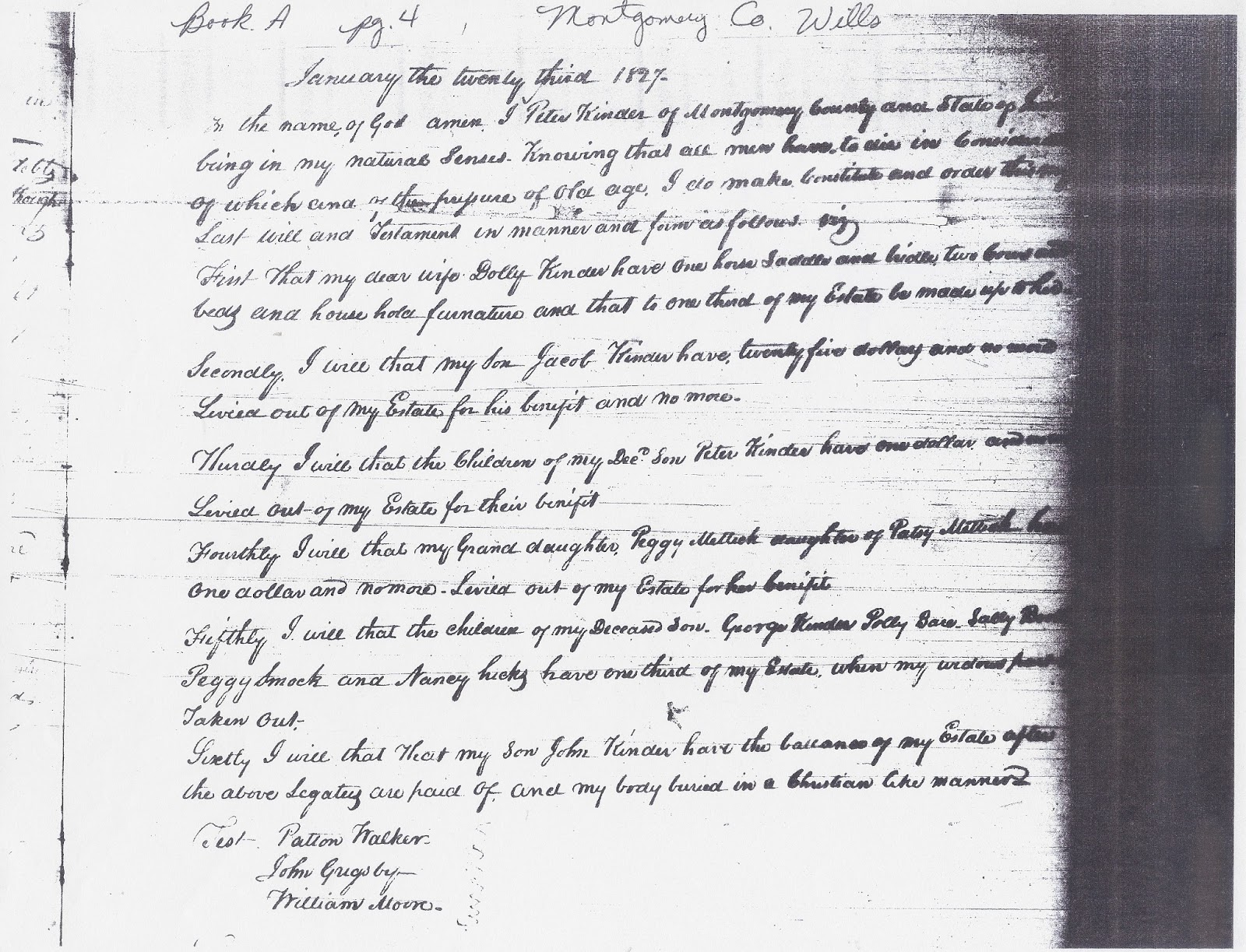
Peter Kinder's Will - Confusing information


I've been working on this Kinder family off and on for several years now. I don't quite know what to make of Peter Kinder's Will. First, here's a little background. Peter Kinder and wife, Dolly See, left southwestern Pennsylvania somewhere in the 1780-1790s. They arrived in Shelby County, Kentucky where they settled for a time. There, several of their children were married, one being my 4th great grandmother, Sarah "Sally" Kinder who married John Booth. After this time period Peter and some of his children moved on to Montgomery County, Indiana which is where he died and left a Will. Some of his children especially the daughters moved to other places. Sarah Kinder-Booth and her family ended up in Jefferson County, Indiana.

There is a lot of discussion on the web about the history of the family, but it is rare that someone produces any documentation to back their assumptions. The transcription of his Will is below, but before we get to that the names of his children and their marriages are listed next to help understand the names in the Will. Many of the dates (birth and marriage) are unknown.
Children:
Sarah "Sally" Kinder to John Booth in 1793 in Shelby County, Kentucky
Mary Kinder married John Barr - date and place unknown
Margaret Kinder to Peter Smock on Aug. 5, 1802 in Shelby County, KY
Martha "Patsy" Kinder to Elijah W. Meddock on April 1806 in Shelby County, KY
John Kinder to Jane Millone on Nov. 11, 1808 in Shelby County, KY
Peter Kinder Jr.
George Kinder to Milly Johnson - dates and place unknown
Jacob Kinder to Nancy Shepard on Jan. 16, 1816 in Shelby County, KY
Nancy Kinder to Jesse Hicks on Feb. 3, 1816 in Shelby County, KY

Now, the Will itself is confusing as it is unclear if some of the children are deceased by this time.
January the Twenty-Third 1817, Montgomery County, Indiana - Book A, page 4
In the name of God amen. I Peter Kinder . . . do make constitute and order this my Last Will and Testament in manner and form as follows, viz:
First, That my dear wife, Dolly Kinder have one horse saddle and bridle, two cows, a bed and household furniture and that to one third of my Estate be made up to her.
Secondly, I will that my son Jacob Kinder have twenty-five dollars and no more levied out of my Estate for his benefit and no more.
Thirdly, I will that the children of my decd. son, Peter Kinder, have one dollar and no more.
Fourthly, I will that my grand daughter, Peggy Mettick, daughter of Patsy Mettick have one dollar and no more - levied out of my Estate for her benefit.
Fifthly, I will that the children of my deceased son, George Kinder, Polly Barr, Sally Booth, Peggy Smock and Nancy Hicks have one third of my Estate when my widow's part is taken out.
Sixthly, I will that my son, John Kinder, have the balance of my Estate after the above legatees are paid of and my body buried in a Christian like manner.


Mt. Pleasant Church, Shelby Township, Jefferson Co., IN - area where Sally Booth's descendents live.

The Fifth group seems to be of the rest of the children. It's unclear which children are deceased except George and Nancy. George is stated as being deceased and his Will is on record in Jefferson and Shelby counties in 1813. Nancy and her family settled in Putnam County, Indiana and she lived until about 1900. There were two John Barr's in Kentucky in this same area as the Kinders so I'm not sure which family to follow to find the daughter, Polly Kinder. There was also two Peter Smocks, but neither one seems to have had a wife named Peggy. I know a little more about my 4th great grandmother, Sarah Kinder-Booth, but I still do not have a time of death for her. The only way to tell which children have died by this time is to try to track each one down to see where they went and when they died. That has been a very difficult job to work on, especially the daughters.

Wednesday, May 29, 2013

Southview/Oak Hill Cemetery in the News in 1926


(View from Southview/Oak Hill Cemetery looking towards town)

While researching another subject I came across an old newspaper article mentioning our beloved old cemetery in Nashville, Indiana. I thought it of interest to many who champion the cause of restoring our oldest cemeteries. You can also see more photos taken of the cemetery stones in the past years on our Facebook page: www.facebook.com/pages/Southview-Cemetery-Nashville-Indiana-Help-us-Preserve-our-Heritage (sorry I couldn't get the link to work)

OAK HILL CEMETERY, in the northwest part of Nashville, is one of the oldest cemeteries in this part of the state, and over two hundred bodies are resting there. Some whose names inscribed on the monument are weather beaten so that is is nearly impossible to know who is resting there, and at some graves the marker or monument has fallen over. It is noticed too, that some of the graves cannot be located for the weeds and underbrush that has grown around them. The road is in such condition that the casket containing the body must be carried to the cemetery and the relatives and friends are compelled to walk. Scarcely a family in Nashville or in this county who have not a relative or a friend buried in this cemetery. A few hours’ work with several men would make Oak Hill a beautiful cemetery. (Brown County Democrat article of June 10, 1926)

Thanks to our Township Trustee for keeping it mowed now. One of the many interesting stones in the cemetery is featured below:

Notie Calvin, Daughter of T. D. & Linda Calvin, Born Sept. 28, 1880, Died Dec. 23, 1892

Monday, May 20, 2013

Lineage Society - Hooray! The Gold Nugget


Hooray! I finally got a break on my grandfather's records. I had tried everything to find one piece of documentation that held all my grandfather's information. The death certificate was blank with no parents listed. The marriage application gave the mother's wrong last name. No birth record could be found for him in any county where he lived. His obituary gave his mother's wrong first name. So I had wracked my brain - what other piece of documentation could I get that would give me the information that I needed? Suddenly it occurred to me - his social security application! That would be the one piece of paper that he would have had to fill out himself. That would be the one government document that would still be available to obtain with just a little effort.

So I got it two weeks ago. After I opened it I did my own little happy dance right there in the post office parking lot. I was elated all week. It gave his full name as George Allen Dunn, address R.R. 4, Nashville, Ind., age 38, born Oct. 28, 1898 in Boone County, Ind. His father's name was George M. Dunn and his mother was Rose E. Ferguson. It was signed in his own handwriting (I recognized his handwriting) on June 4, 1937. It looked like two people had filled it out because some of it was printed and some of it was in cursive, but I know he had to have had direct imput on this document.

I didn't know that Social Security dated back that far - 1937. I'll keep this information for future use. I may be able to use it again for another ancestor's records. Now I can proceed forward on my application for Jefferson County First Families membership. This document was well worth the wait. Time to get back to my notebook to see which piece of documentation I'm going to have to look for next. One note, I received another copy of the same document a week later. Looks like they were making sure it got sent out.

Wednesday, April 24, 2013

Off to See the Wizards [of Genealogy]!

Hopefully we'll get to meet some new attendees from those of you that are going to the Indiana Genealogical Society's Annual Conference this Saturday, April 27. I try to attend every year hoping that the great genealogy wizards that be are going to bestow some new knowledge on me. Maybe as in the Wizard of Oz they will give us some great gift of wisdom to help us become better researchers. This year it is close to my home of Brown County, Indiana so I am really excited to go. This year's featured speaker is D. Joshua Taylor from the NBC television series, "Who Do You Think You Are?" I always look forward to hearing from a new speaker, a new perspective.

I have heard a few comments from those that have decided not to attend. To them I always respond that "you can never stop learning." Some of the titles could be presented a little more interestly, and many times that has helped me pick which session to attend. If a session title sounds particularly interesting I almost always pick that one. I've even attended sessions that I didn't think I would ever use just so I could further my own education.

So my collegues and I hope to see you there. If you happen to be driving down to Bloomington by way of Brown County be sure to enjoy our beautiful scenery and our little historic town of Nashville.

Saturday, April 13, 2013

Lineage Society - More Document Problems


George A. Dunn and oldest child, Lucille ca. 1923

Another round of problems have surfaced with grandfather's records. For years I've tried to find a birth record for him. He was supposedly born in Hamilton County, Indiana on October 20, 1898. The neighboring counties were also checked: Boone and Tipton. The Dunn family was known to have lived in northwestern Hamilton County between Sheridan and Cicero so it was wise to check those two counties. If a doctor attended the birth he could have come from either of those areas too. The problem also came up with another one of his siblings so I'm assuming it was a home birth with no doctor attending.

Okay, so I don't have a birth record. What other records would be good to give a birth date and parents' names. There is the marriage record and the death record; these would be the next best alternatives. Going to get a copy of grandpa's death record was another big let down. It did give his birthdate so that would help. The problem was that the parents information was left blank. I thought in modern day America all information was required to be filled in on a death record. Grandpa died in 1978 in Bartholomew County. Isn't it required to have all this information on a death record?

The next record to try for was Grandpa's marriage record. He would have filled that in himself, and surely he would know who his parents were. So I made the trip to Johnson County, Indiana. On the marriage application it read George Allen Dunn to Goldie Edith Roberts. The birthdate was there. Okay, that's another piece of evidence for the birthdate. Reading on down Grandpa gave his father's name as George M. Dunn. Okay, that was right. Then he gave his mother as Rosa Woods. What! I well knew her last name was Ferguson. Where did he get Woods? I guess he could have been a little nervous before the nuptials and all of a sudden forgot his mother's name. Was it possible that the bride-to-be filled in the information and she just got it wrong. Grandpa, you're not helping!


Goldie Dunn and baby son, Vonda ca. 1923

Next let's try the obituary. Someone in the family most likely gave that information so maybe all the information I need will be there. So I trucked on over to the Johnson County library to look at newspaper microfilm. Looking for that ONE piece of information that I need maybe the obituary will be it. Reading on down the obituary it gave his birthdate and a birthplace, Boone County. Well, that will help. At last, a birthplace is stated in writing. Now for the parents - the father was stated as Mose Dunn. Mose was George M. Dunn's nickname, that will do. And, I do have his father's correct name on the marriage record. The mother's name was stated as Loretta Ferguson. Now what! Where did the name, Loretta, come from? Why is it so hard to find his mother's correct name? I've never came across so many errors and ommissions on any one person as Grandpa Dunn's records. You would think it would be harder to get information before the 1900s. I guess I'll have to treat this one the same way as Rose Etta Ferguson's records. I'll have to use all these records and try to explain the discrepancies on my application for the First Families of Jefferson County.

Then, I had another idea come to me. I do my best thinking in the morning it seems while I'm driving to work or cleaning house. What other documents could I find that would give me the information I needed? I need a document that Grandpa would have filled out himself. I need a document that requires complete information - a government document of some sort. Then it came to me - a document I have ordered only one time before, but it solved another big genealogy problem. I had gotten this document for another grandparent in the past that had a mysterious past and it helped to solve the mystery. I looked on-line. How can I order a Deceased Person's Social Security Application (form SSA-711)? I looked on Ancestry.com and got my Grandpa's social security death information. The link on Ancestry did not lead me directly to a place where I could order the application. So I clicked on Google and did the search. Now I just have to wait. I'm a little excited - please Grandpa I hope you got this one right! It may take a few weeks, but I need this document so I can wait patiently. I'll let you known how it turns out, keep your fingers crossed!

Thursday, March 28, 2013

Lineage Society - Document Discrepancies


Rose Etta Ferguson-Dunn

I finally took a day to go collect documents for my immediate family. I started early on a Wednesday morning and set my trip meter on my car. I was curious as I started out my day as to how many miles I would end up driving for the day. I covered a four county area of Brown, Johnson, Shelby, and Bartholomew in central Indiana. From my checklist of 40 documents to collect I already had most of them from previous years of doing research on my Ferguson family. The only ones I still needed to get were for my immediate family. I still needed my father’s birth certificate, two of my grandparents’ death certificates, and one great grandmother’s death certificate. The reason I had never gotten hers is that I had seen the information a few years back and it was incorrect. So now I need to decide if I can use this as a form of proof for something else – maybe her birthdate or proof of a burial place.

Here is my dilemma. Rose Etta Dunn’s documentation has been sketchy at best. According to her obituary in Johnson County she “was born at Madison in 1865 and had moved to Johnson county nearly twenty years ago living for fifteen years in and near Trafalgar.” It named her children one of which was my grandfather, George Dunn, of Johnson County. There were no other details about her husband, her other residences, or her parents. From that I had to find out who her husband was and where were they married. I did have some information from her other children about her husband and where they lived before coming to Johnson County. There was no marriage record for her in Johnson or Jefferson Counties. So the next thing to do was to get her death certificate.

Her death record gave sketchy information.
Age 64, spouse George Dunn, died August 4, 1928, buried at Greenlawn Cemetery in Franklin. Her father was David Ferguson and the mother was unknown. By this time I had found that her father was John B. Ferguson from her marriage record so the last name was correct but not the first. She did have an uncle by that name though.

For her marriage record I had previously written to Hamilton County Library’s Genealogist to see if they had any info on this family. They very graciously mailed me a huge envelope filled with goodies on my family. One of these was Rose Etta Ferguson
S and George Dunn’s marriage record. Their marriage record (application) stated his name was George M. Dunn of Sheridan and gave his full information. For Rose Etta hers said her name was Rosette Furguson, she was 26, and of Sheridan also. Her father’s name was John B. Furguson and her mother was Lida Lowell. George and Rosette were married on Feb. 18, 1892. Another page was from another marriage book that showed the marriage license information. This page was very enlightening. I had never been able to connect Rose Etta back to Jefferson County with any parents in the census until I got this one. At the top of the page it read George M. Dunn to Lusetta Ferguson. At the bottom they both signed their names as G. M. Dunn and Rosette Ferguson. That was a shock, no wonder I couldn’t find her. Did she change her name? Did she just not like the name Lusetta and prefer to be called Rosetta? The name Rose Etta or Rosetta is the name she had gone by all her life except for the time she lived in Jefferson County. So now I ponder what her full name was – was it Rose Lusetta Ferguson – maybe Etta was short for Lusetta? Or maybe she just didn’t like Lusetta and just started using Rosetta instead.


George and Rosetta's Marriage Record

These two marriage documents were the best proof to link her to her parents back in Jefferson County. So now the question is what do I do with her death certificate? Do I use it and attach an explanation with my First Families application? Should I not even include it so I won’t confuse the application people? Would it be best to include all her documents and explain the discrepancies. Would this help to improve my overall application for First Families? That would probably be the best route to go, but I’ll have some thinking to do. By the way at the end of my day I had logged over 119 miles- yikes!

Sunday, February 24, 2013

Lineage Society - Records Survey


George A. Dunn (left) holding Lucille, Smyser boy, George's wife, Goldie holding Vonda, and other Smyser children - Trafalgar, Indiana.

I'm going to use this blog as a journal to detail my journey to become a member of a local lineage society, "Jefferson County, Indiana First Families." Last blog post I gave an overview of what I wanted to do. Now I'm going to get started by surveying what records I already have and what records I still need to get. I found an old 3 ring binder that I wasn't using and put in some tab dividers - one for each generation of ancestor. They start with me, then my father, Vonda, then third is my grandfather, George Allen Dunn, fourth is my great grandmother, Rose Etta Ferguson, fifth is her father and my ggreat grandfather, John B. Ferguson, and finally his father, Joel Ferguson. I thought about adding another tab for John B. Ferguson's wife, Lydia Ann Lovell, and her father Jonathan Lovell. Jonathan came to Jefferson County about the same time as Joel Ferguson. I still may do that later on. For now I'm going to concentrate on the Ferguson line.


Next, I made a checklist of what documents I need to get together. I'll need a birth and a death record of some sort for each person. Then finally I'll need to get land documents to prove where and when Joel Ferguson first settled in Jefferson County. Birth and death records are relatively easy to get for the later generations. My father recently passed so I have a death record for him. My grandfather's death record can be gotten from the county he died in so that will be my next task. As for a birth record for dad, I don't have that one either so I'll have to get that one. My grandfather, George, doesn't have a birth record because I had already tried to find that years ago. He was born in Hamilton County and they had no record for his birth. I had already checked in the neighboring counties, Boone and Tipton, and found none there either. I can probably use his death record as an alternate record of his birthdate.


The next generation, Rose Etta Ferguson was born in 1864 before Indiana required Births to be recorded so I'll have to come up with an alternate source such as her death record or marriage application. I already have both of those. The same goes for John B. Ferguson. He was born in 1817, so I can probably use his death record to get his birthdate from. As for Joel Ferguson he died in 1869 so that puts both and birth and death records before the Indiana requirement. So I'll have to use alternate forms of documentation for his dates also.

Next, I'll have to get together land records for Joel Ferguson which I had already done a few years back. I started to gather all the documents I have and pulled them from my files. They'll go in the 3 ring binder. I also put the checklist in the very front of the binder so I can check off what records that I have already put in the binder. The ones I still need to find will be on the checklist unmarked until I get them. Alternate documentation can be gotten from burial/cemetery records, obituaries, census records, marriage records, etc. I can make a note of that on my checklist as I go. I know in the early years of my genealogy research I was a little lax at documenting my sources. I'll need to make sure I have a source noted on the documents I already have. Time to get to work.

Wednesday, January 30, 2013

Lineage Society - Ferguson line


John B. Ferguson - Olive Branch Cemetery

Well, I've finally succumbed! I always looked upon Lineage Societies as a waste of my time. I saw no benefit in it to me as a genealogist. Now I'm going to go through the application process for the main purpose of getting my family published at least in the local Genealogy Society. I have one family line that I can say is one of my more favorite familys to do research on. My Ferguson line from Jefferson County, Indiana was one of my real research ventures and I learned a lot in the process. I also think that going through this application process, compiling my records, and putting together my presentation will be another good learning experience. It will be a good test to see if I have been doing my documentation the way it should be done. I already have most of my records together when I did the research on my Ferguson a few years ago. Now when I start reviewing all my records I'll soon be able to tell if I really am prepared or if I'll have to start over.

The Jefferson County Genealogical Society offers a program called "The First Families Program" for those who want to prove that their ancestors was one of the early settlers to that county. They have three options and the first of which I'm going to try for is 'Frontier Family. I have shared with other Ferguson researchers my research on the Fergusons over the years. I have most of my documentation already collected on the earliest ancestors in that line. Now all I have to do is go back and get together records on my later ones such as my father and his father; something I had neglected to do in my great hurry to see how far back I could go. My line of ascent past my dad goes as such: my grandfather - George Dunn, my greatgrandmother - Rose Etta Ferguson, my gg grandfather - John B. Ferguson, my ggg grandfather - Joel Ferguson.


Joel Ferguson was born abt. 1772 in Virginia, died Sept. 21, 1869 in Jefferson Co., Indiana and is buried in the Demaree Cemetery. He came to Jefferson County via Shelby County, Kentucky abt. 1815. I need to prove that Joel Ferguson was in Jefferson County by 1820 - that will be the thing I need to prove. He is in Switzerland County, Indiana in the 1820 census. All I need to find out is if that part of Switzerland County later became a part of Jefferson County. Joel Ferguson first married in 1815 to Peggy Hannis, a widow of Charles Rogers. Then by 1816 they were supposedly in Switzerland County when their son, James was born. Joel hadn't purchased any land so I don't have a deed to fall back on. Peggy died sometime around 1820-21. On January 6, 1822 Joel Ferguson married a second time to Mary Ann 'Polly' Booth. They had nine children. It was with this second marriage that Joel and Polly got their land grant.

Unfortunately that is too late to use as proof of residence before 1820. The second option that the "First Families Program" offers is the category 'Founding Family' which you only need to prove residency by 1860. at the very least I will try for that one with the intent on going all the way back to 1820. This is going to be a lot of work, but it might be fun! You can check on the program at their website: www.jeffersoncountygenealogicalsociety.org


Sunday, January 13, 2013

Investigating an Incorrect Obituary - George M. Dunn


George Monroe Dunn

An obituary is only as correct as the information that was reported by a third party. If you ever have to write an obituary please don't forget every member of the family even if you don't particularly like the person. What you put in writing will be there for an eternity. With the recent passing of my father an incorrect obituary was printed in one of our local newspapers. The paper did print a correct one a few days later, but that first information that was put out is still in everyone's mind that first read it. It named me and my sister as stepdaughters to our father, when in reality we were both adopted by both our parents. Also, his wife of 50 years was completely omitted. This is especially harmful for genealogists - we need the correct information. Maybe in 20 years or more when we are both gone, someone will find this obituary and wonder "who was his wife?" Then they'll have to go through all the trouble to look for a marriage record. Then they'll see the marriage date and wonder again "how did these girls become stepdaughters to this man?"

This problem also came about a few years ago when I found my great-grandfather's obit.
“January 9, 1933 - Noblesville Daily Courier.
ANOTHER CIVIL WAR VETERAN DIED SUNDAY - George M. Dunn, one of the last civil war veterans of Hamilton county, died Sunday morning at the home of his daughter, Mrs. Mary Hatfield, in Cicero., with whom he had been living for several months, at the age of eighty-seven . . . He served three years in the civil war . . . his death leaves less than thirty-five of these veterans still living in the county . . . The deceased spent most of his early life in the vicinity of Boxleytown. His wife died many years ago. He is survived by the following children: Mrs. Mary Hatfield, Mrs. Maggie Scott Miller both of Cicero, Mrs. Josephine Adair of Riverside, Calif.; Fred Dunn, of Maywood, Calif.; and Charles Dunn, of Indianapolis.”


I had heard stories from family members that George had outlived three wives. So here it was - his obit, great grandpa George had been married before and here were the names of his other children. I know I had the right family from all the other evidence I had collected. I relayed all this information to my father and he said he remembered having an uncle Charles. Dad used to go visit him in the summers when he maintained a vegetable stand at the old Farmer’s Market in Indianapolis. But I don’t know why his family back in Johnson county had been left out of the obituary like they were never a part of George’s life. The obit never named the other wife that he had survived either.

There were clues here, but a lot of work had to be done to fill in all the holes. There were birth records to be found on all the children - whose names were given as their parents? There were marriage records to be collected - maybe they would help fill in some of the gaps? Where were these other people buried, where did they live, did any of them keep in contact with their half brothers and sisters? Then there would be questions that would probably never be answered such as why were all the other children and other wives omitted? This one took a while to investigate, but at least the few clues that it left gave me something to start on. Omissions are the hardest to find and correct. So if you find yourself in a position to create an obituary please make it correct to the best of your ability.

Sunday, December 23, 2012

Lucretia J. Smith - Someone's Daughter?


Once in a while in your genealogical research you may come across one of those families that seemed to have moved around a lot, at least it seemed so in the census years. You need to keep in mind though that the census was taken every ten years and a lot can happen in that ten year stretch in between times. Such was my problem trying to find the parents of this little girl, Lucretia J. Smith. I had recently took a day and photographed all the tombstones in one of our small older cemeteries in Brown County, namely the Southview Cemetery. (See the Southview Cemetery facebook page: https://www.facebook.com/pages/Southview-Cemetery-Nashville-Indiana-Help-us-Preserve-our-Heritage/220269917991135) Every once in a while when I go on one of my pet projects I come across one person that intrigues me, such was the case with Lucretia. I just had to find out who she was and who she belonged to.

Her stone was barely legible, but you could read her name and part of a death date - possibly 1860s. Also it seemed to read "Daughter of L. & H. V. Smith." She appeared to be buried in a family plot with a Lucas family. Two other Smiths were buried nearby, one a Thomas J. Smith and a Leander Smith. Thomas' stone read "Son of Margaret Smith, Died Feb. 22, 1866, Aged 5 years, 4 months, & 18 days. The other one was a Civil War stone for a Leander Smith with no dates on it. It read "Co. K, 145th Indiana Infantry." Now this could possibly be the beginnings of a family for Lucretia. Her stone had named an L. Smith as a father, but the mother was named H. V. Smith. So the search was on for other documentation.

First, a search for a marriage record for Leander Smith was necessary. One was found for him and a Margaret which resulted in bewilderment. Leander Smith married Margaret Lucas on May 3, 1867 - after her son (?) Thomas J. died in 1866. In the 1870 census Leander Smith is found living alone in the next household by Harrison Lucas who has a daughter named Margaret age 32. There is no sign of them living together or any young children as a result of their marriage in the Smith name, more questions arise. Then there's the question what happened to Lucretia's mother, this mysterious H. V. Smith? There was no sign of Margaret or an H. V. Smith buried in this cemetery. Why had Margaret named her dead child, Thomas J. Smith? Why can't I find Leander in earlier census records with another wife and a daughter named Lucretia?


On a whim I decided to look at Divorce Records for Brown County. There I found more pieces to the puzzle. "Leander Smith vs. Harriet V. Smith - filed Dec. 3, 1864. Married Dec. 5, 1857, Harden Co., Iowa. In July of 1862 they moved to Hamilton Co., Indiana where they lived until May of 1863 when Harriet 'eloped' with John J. Robison; they now live in Iowa. Depositions are to be taken from Edward Anderson, Stanton Teeters, and John Smith of Noblesville, Hamilton Co. . . Leander to have custody of their daughter, Lucretia J. Smith, age 5 in 1865 and Harriet to have custody of their daughter, Sarah E. Smith, age 3 in 1864."

That answered most of my questions, except one. Why did Margaret Lucas bury her son, Thomas J. under the name of Smith? Possibly, she couldn't afford a tombstone for him until much later. Maybe her new husband did this for her and she was grateful to him; she wanted to give her son his name. One can only wonder about her reasoning. It seems in the later census records Leander and Margaret lived together as man and wife, but had no other children. Leander died in 1895 and Margaret filed for his Civil War pension. So far no more has been found on Margaret or her final resting place.

Sunday, December 09, 2012

Draper Manuscripts - Booth Research


Still looking for scraps of information for my illusive ancestors I have been collecting historical accounts that might mention any of them. Even if it is just an historical account of their home county or city, etc. This time I got interested in something that some of my older collegues kept mentioning, but I thought it was out of my reach. So I started digging to see if I could find how I could get a hold of these famous Draper Manuscripts. From all the research I did they said I should first get a copy of the Guide to the Draper Manuscripts. So I finally ordered a copy for our local Society to be put in our local library. You can get a copy from the Wisconsin Historical Society Online Store at http://shop.wisconsinhistory.org

I finally got my copy last week and am anxious to go through it. I first decided to make a list of all my ancestors that I want to look up in the index. I also want to look for those persons related along the side lines such as son-in-laws, some of the neighbors that I found listed elsewhere, etc. So I got a little excited at first and started browsing through the guide. There is a lot more to this guide than just an index. The first section describes what each set of manuscripts covers. I was able to pick out a name (some of the more common names such as John Smith) and compare it with what the description of the particular manuscript is about. That way I was able to narrow down which area of the country that was closest to my ancestor.

I did get one definite hit so far. There was a listing in the index for a James Booth, hopefully mine, that had written a letter about an Indian attack in Wheeling, WV. One of these letters is by James Booth concerning an attacks in 1777-78 on the Charles Grigsby family. My James Booth was known to be in that area about that time. In fact, I had previously found an historical account of how Captain James Booth had been killed in an Indian attack in 1778 in Harrison County, WV. Even if this is just a one page letter written by my James Booth, it would be one of the most valuable items I could acquire.

Captain James Booth left a family with children. I am a descendent of his son, John Booth. His son, John, was also involved in military service during the Revolution. John Booth eventually moved to Indiana which is where my family is from. I'm getting excited about this, but I need to slow down and finish that list. I need to try to cover all my ancestors. Who knows what else I might find.

Sunday, November 18, 2012

A Sense of Community - Sunday Adventures with Dad


Me and Dad, 1955

Remember when you were little, every time dad (or mom) had to run an errand “Daddy can I go too?” My dad and I were inseparable when I was little. Today all these memories came rushing back at me. Sundays are my hanging out day with my longtime boyfriend. His usual routine is that he has to go somewhere to get a cup of coffee - the local countrystore or the local gas station, so I just usually tag along. Sometimes we run errands, like today, we had to go get a new battery for the John Deere before bad winter weather hits. On the way back he had to stop and talk to a guy that has an old truck for sale. While I was standing there in the sunshine watching them, this wave of memories came flooding back about the days I used to go with dad everywhere. Mom took endless photos of dad and me doing things together. I was too young to remember most of it, but the photos keep that memory for me.

Then this brought to mind another thought, is this the sort of thing that my ancestors did. So many community connections were made and good relationship formed. Did my grandfather do the same thing, did my great grandfather? Standing there in the sun watching them I thought, what if great grandpa had to go down the road and visit a neighbor, maybe he had a part for his wagon or maybe this neighbor knew how to make one for him. I know living in the country now I seldom go into town unless I need groceries for the week. If we need a loaf of bread I just jump in the car and go to the local country store. What if great grandma was out of something for her pie, maybe she just sent one of the kids on horseback to the local country store to get some sugar or maybe they walked across the field to the neighbors to borrow some. Each one of these visits to neighbors or local businesses helped to form relationships in their small community.


Maybe a certain person in the community did blacksmith work so the word was passed around the community. Maybe the old widow down the road sold eggs for extra income or maybe she did mending. The word was spread around to all the women in the community. Neighbors helped neighbors so this fostered a sense of community. Sometimes a day long trip had to be made into town or to see a particularly important person to the family in some other town. That sense of community was spread a little farther. Maybe the man at the barbershop would ask, “How are things out your way?” Then the news from the far reaches of the county would be conveyed to other folk in other parts. Maybe in turn we would learn of a new technique to plow a field or learn about the new doctor in town.

Communication was by word of mouth, our ancestors had no televisions or internet. People were the center of their lives, not things. All these interactions and relationships formed a sense of community. We need to remember that our ancestors might have formed many, many interrelationships with their neighbors – close and far. Every time I visit a neighbor I think of the relationships we will form, can they help me out sometime, can I help them sometime. Will these relationships last a lifetime? Will they influence my life somehow, I'm sure they did our ancestors. I think of how so many of my ancestors would move out west only after someone would come back home and tell them of the new and better land they would find. These had a profound effect on their lives too. We need to get back to the values of our ancestors; we need to go back to a people-centered community.

Sunday, November 11, 2012

Journal Kept on the River Ohio 1774 - Thomas Hanson's Account


I found this little book among some others that I acquired from another Historical Society who was getting rid of some of their collection. I sat down and read it in a couple of days and it was very interesting. It is a diary of a Kentucky explorer/surveyor about a summer spent traveling down the Ohio River and in through Kentucky surveying out parcels of land to be settled by pioneers and military veterans. The diary was so small I was able to index names of individuals named in it. These individuals were men who were in the surveying party, or who would receive the land surveys, or those they met along the trip. As I read it many questions arose in my mind about my ancestors in this part of the wilderness. Read my previous post on this topic. Following I transcribed a few of the more interesting passages in the diary. The entries start April 7, 1774 and end August 9, 1774.

April 7: We left Col. Wm. Preston’s in Fincastle County at one o’clock in high spirits, escorted by him three miles; eight of us being in company, viz: Mr. John Floyd, assistant surveyor, Mr. [James] Douglas, Do. Mr. Hite, Mr. Dandridge, Thos. Hanson, James Nocks [Knox], Roderick McCra, & Mordecai Batson. We traveled fifteen miles to John McGuffin’s at Sinking Creek.

May 13: Mr. Douglass made a survey of 2000 acres on the upper side of the Creek [near Big Bone Lick] for William Christian, good land. At Mr. Douglas’s return we embarked & floated down the River to Kentucky, 47 miles & by daybreak landed. In our passage we came to an Indian Camp, landed & found two Delawares & a Squaw, we gave them some corn & salt.

July 6: Mr. Floyd, Nash, McCra, and Hanson left the rest of the company with an agreement to meet at Mr. Harrod’s cabin [Colonel Harrod of Harrodsburg fame] 20 miles off, higher on the Kentucky.


Present day Otter Creek - Wayne County, Kentucky

Names mentioned in the diary: Mr. Allen, Mr. Arbuckle, Mordecai Batson, Mr. Blackburn (of Rye Cove), Mr. Boyer, Matthew Bracken, Col. Bullitt, Robert Carlile, William Christian, George Rogers Clark, George Clendennin, Dr. Connelly, James Cowan, Mr. Croghan (Croghan's Fort), Mr. Dandridge, Lawrence Darnell, Dickerson (indian) Col. Donaldson, James Douglas, Lord Dunmore, Ephraim Fields, Maj. John Fields, John Floyd (surveyor) Mr. Glen, James Hamilton, James Hanson, John Hanson, Thomas Hanson, Mr. Hardy, Capt. Harrod, Patrick Henry, William Henry, Mr. Hite, Mr. Hogg (of Pokatalico River), Mr. Holloway, Mrs. Ingles, Walter Kelly (of New River), James Knox (or Nocks), Hancock Lee, Col. Andrew Lewis, Gen. Benjamin Logan, John May, Mr. McCorkle, Roderick McCra, Mr. McCulloch, John McGuffin (of Sinking Creek), Dr. Hugh Mercer, Mr. Nash, Col. William Preston (of Fincastle County), Hancock Taylor (asst. surveyor), Michael Tygert, Mr. Waggoner, Mr. Ware, and Colonel Washington.

Monday, October 15, 2012

A Personal Connection to Your Ancestor


Every time I find a little book on local history or an historical diary my curiosity gets the best of me. I've done my bit on gathering names, dates, and places in search for my genealogical origins, but there is so much you can do at any one time without traveling to the out of the way places. So when I find one of these historical accounts I want to jump back in time and ask, which of my ancestors could have lived here while this was going on?

Our neighboring county, Monroe County, Indiana called me a few months ago and informed me they were downsizing some of their collection. So I made a visit to their History/Genealogy library to see what they had. I was determined to find some good items and bring them back to share and hopefully place in our local library for visiting genealogists to use. I wanted our local Genealogy Society to have use of them for a short while before they went to the library for a permanent home. Much of it was historical accounts/genealogy records from other states that covered local items such as church records, marriage records, etc.

My latest find was a short little booklet of a diary of a Surveyor traveling down the Ohio River in 1774 by Thomas Hanson. This brought to mind several of my ancestors. My Conners were surveyors when they moved into Kentucky territory. Traveling down the river is how many of our ancestors traveled especially when the forests in the wilderness was so dense that daylight hardly made it to the ground. I had even previously found an account written by a neighbor of my Booths that described the lower part of Indiana just this way. I just knew my John Booth had seen the same sight! For a short minute I found a way to make a personal connection to him.

My Samuel Stalnaker is mentioned in another historical account as having inhabited wilderness areas in southern Virginia. The accounts are made by travelers in the wilderness that came upon Stalnaker's cabin. It is a short mention of him, but at least it is a glimpse into his life. I guess what I'm seeking is to somehow make a connection to my ancestors that lived so long ago. After all their blood runs through my veins. I want that personal connection more so than just a cold DNA relationship.

Friday, October 05, 2012

Which Haithcock is Charlotte's Father?


1790 Chatham County, N. Carolina Census

I had made a short-lived attempt the last time that I started doing research on Charlotte's family. Truthfully, I was a bit more inexperienced. I'm going to delve into this again with a little more determination this time. Charlotte Haithcock/Hathcock/Heathcock is my 4th great grandmother. She married Charles Riggins somewhere in North Carolina. From my last post I related my quest on the internet to see what I could find. According to the posts that have been copied over and over again her father was a Scout for General Francis Marion in the Revolutionary War.

Chatham County seems to be place this family occupied for the longest time. According to the census there are four men living there in 1790 about the time she was married that could be her father - James, Hosiah, William, and John Haithcock. Gathering the information from the census record only three of these men have females in the family. This in itself is not a deciding factor to drop one of these men, but I'll make a note of it for now. I may have to make a decision later on the preponderence of evidence in one man's favor. From family trees that have been posted there is a possibility that there could be two more that may have lived here for a short time - Isaac and Charles Haithcock. The consensus seems to be they are all brothers or some other sort of kin. I'll go along with that since it is such an unusual name and all living in this same county.

Then the next problem is how does one sort out which one could be her father? Going on the assumption that he may have been a scout in the war then the next step would be to look for military records for all of these men. From my first attempt to find her father I had already gone through the ususal records such as Wills, Probate, Marriage Records, Deeds, Tax Lists, etc. This new more determined quest will be to survey what other types of records are available and how this could help to prove which man is her father. Also I will start a timeline and try to fill in the blank years with whatever records I can find. Hopefully I've gained a little more knowledge and experience this time around.

Wednesday, September 26, 2012

Looking for Scraps for my Mysterious Haithcock

When you've hit a brickwall with one of your ancestors what do you do? You grab at any little clue that might give you a lead to continue on. I have several of my lines that come from North and South Carolina that go back to the Revolutionary War era. One of those that have intrigued me most is my Haithcock line. There is a lot of information on the web about the Haithcock surname and its origins. That's good, but I still need to find that one man that links from my line to the Haithcock line that has been researched.

I've traced my line back to the north central portion of NC touching on the counties of Wilkes, Guilford, Randolph, and Chatham. My line goes back to when Charles Washington Riggins married Charlotte Haithcock in the 1790s. I've found countless posts on this marriage and this family, but very little on Charlotte's origins. A most mysterious post that has been shared by many researchers on the web makes one statement. Charlotte Haithcock's father was a scout for General Francis Marion during the Revolutionary War. I don't know where this statement originated from and how many times it has been circulated. I do know that one of those statements as gone as far as naming her father as "Scott" Haithcock, obviously twisting the word "scout" into the name Scott. I've contacted countless of these people asking for documentation or a clue as to where they got their information.

Not fully trusting any of these posts I have got to do my own research. Dutifully searching the web I found a list of General Francis Marion's regiment - pay roster - with no mention of a Haithcock. How do I know how complete this list is, and as a scout maybe he was not paid as a regular soldier. I've rented microfilm for all these counties and searched all kinds of records. So now I've taken to picking up any historical account I can find and reading it.


King's Mountain National Military Park

So I found this little pamphlet entitled, "Kings Mountain" put out in 1955 by the Kings Mountain National Military Park. I was willing to dig for any kind of information I could find that might tell something about that area of the country during the Revolutionary War. It was a very interesting read. It is so hard to find any historical account of what went on during this war other than a compiled history in a few paragraphs in a history book. I want details. Was General Francis Marion involved in this battle? Who were these men that fought this war in North and South Carolina? Could I find a clue about my ancestor - this Haithcock? Every little bit I read leads me onto some other reference. There's got to be a clue somewhere. My next read is to find the book on General Francis Marion by William Gilmore Simms. I've heard this is the best historical account written. If anyone knows of anything else that might educate me better on the history of this area during the War I would appreciate any suggestions.

Thursday, September 13, 2012

Owl Creek Boys - James M. Yoder


Taken at a Reunion of the 82nd Indiana Volunteers 1906

James M. Yoder - Taps Sounded for Civil War Veteran
From the fast thinning lines of the once vast host that wore the uniform of blue, James M. Yoder has been mustered out. He goes to join the ranks of those now arrayed in the service of the Great Commander beyond the veil that divides time and eternity.
Mr. Yoder succumbed last Friday at his home on Owl Creek, about two miles west of Nashville. Just three days previous he passed his 88th birthday. He was born in Monroe County, Indiana on April 21, 1843. He moved with his parents to this county when he was two years of age. He had been married twice. His first wife was Catherine Waltman and to them was born one son, Marion Yoder, of Indianapolis. His first wife died April 25, 1872. Later he married Eliza J. Baughman and to this union 12 children were born: Ira, Ida, Cyrus, Myrtle, Maud, Edith, Boone, Roy, Ralph, Dorval, John and Pearl. Nine of the children and their mother survive.

At the outbreak of the Civil War Mr. Yoder enlisted in Company D, 82nd Indiana Volunteers, and served three years, or until the close of the war. He served with credit and was mustered out with the rank of Corporal. In politics Mr. Yoder was an ardent Republican and took an active part in the work of that party. At various times he served as delegate to state conventions. He was a member of the Baptist Church. He took a prominent part in the activities of the G. A. R. On every Memorial Day he was a familiar figure in the services, paying his tribute of remembrance to the comrades who had answered the call.

Funeral services were conducted at the Methodist Church in Helmsburg Sunday afternoon, at 2 o’clock, by Rev. W. C. Chafin. Burial was in the Lanam Cemetery. The burial services were in charge of Jules G. Ord Camp, No. 40, United Spanish War Veterans, of Columbus, under the Command of John E. Taggart. Mr. Yoder became an honorary member of the Ord Camp last November, at which time James Bond, Benjamin F. Sibert, Ambrose Bartley, and William Devers also became honorary members. These four members were present at the funeral. They are all who are left of the Civil War veterans in this county. “Uncle Jim” as he is familiarly known here, expressed the desire to Commander Taggart to be given a military burial. Thus another defender of this great nation has joined the ranks of those who have passed on before.
(Brown County Democrat, April 30, 1931)

Saturday, August 25, 2012

Owl Creek Boys - Ezekiel M. Tomlinson


One of our Owl Creek boys that was mentioned in the newspaper article at the beginning of this series paid tribute to one, Ezekiel Manville Tomlinson, who was a Civil War veteran. He was born on June 30, 1843 in Indiana. His parents were John Tomlinson and Mary Joslin. He was living with his parents in the 1860 census in Washington Township and when he joined the military he was single. He went by Manvil most of the time. He and his family came from the valley just west of Nashville called Owl Creek. When the war broke out he was registered in the Draft of 1863 with information stating he was age 20, a farmer, single, and born in Indiana. It’s not clear how long he served in the war without seeing his Draft card. The Indiana State Archives maintains copies of these on microfilm. From his Civil War Pension card he served in Company K of the 145th Indiana Infantry. Also from his obituary his funeral was conducted by Jackson Woods Post G.A.R of which he was a member.


Manvil Tomlinson's Civil War Pension card

After he came back from the war, Manvil was married to a young lady by the name of Sarah Rebecca Coffland. Some records say she was a Coffman, but there wasn't any Coffmans in this part of Brown County. More than likely she was a sister to the Coffland brothers, George and Samuel, who were from the same neighborhood and who also served in the War of the Rebellion with Manvil. Nevertheless, their marriage record reads, Zekial M. Tomlinson was married to Rebecca Coffland on Sept. 10, 1864. From this union they had two known sons, Hiram Alonzo and Charles C. Tomlinson. Rebecca died sometime around 1882. Manvil applied for guardianship over his two sons in 1883 and the Guardianship records refer to Sarah R. Tomlinson’s Estate.

On Oct. 28, 1882 Manvil married a second time to a Martha Lindsey. From this union he and Martha had five children of which three survived to adulthood: Estella E., James A., and Allen Tomlinson. Manvil died March 26, 1921. Martha is buried next to him and she died in 1925. He and three of his sons, Hiram, Charles, and James are buried at the Greenlawn Cemetery in Nashville. Manvil has a Civil War stone.